
"...public order or for preventing incitement..."
India's internet shutdowns and blocking of social media get it unwanted attention from Rihanna et al; Myanmar blocks social media to quell dissent.
(Short one today, due to Substack’s email truncation issues, so more to follow next week. Also: Myanmar isn’t generally considered part of South Asia, despite bordering India, but what’s going on right now is a wee bit important.)
Indian Farmers’ Protests Digitally Suppressed
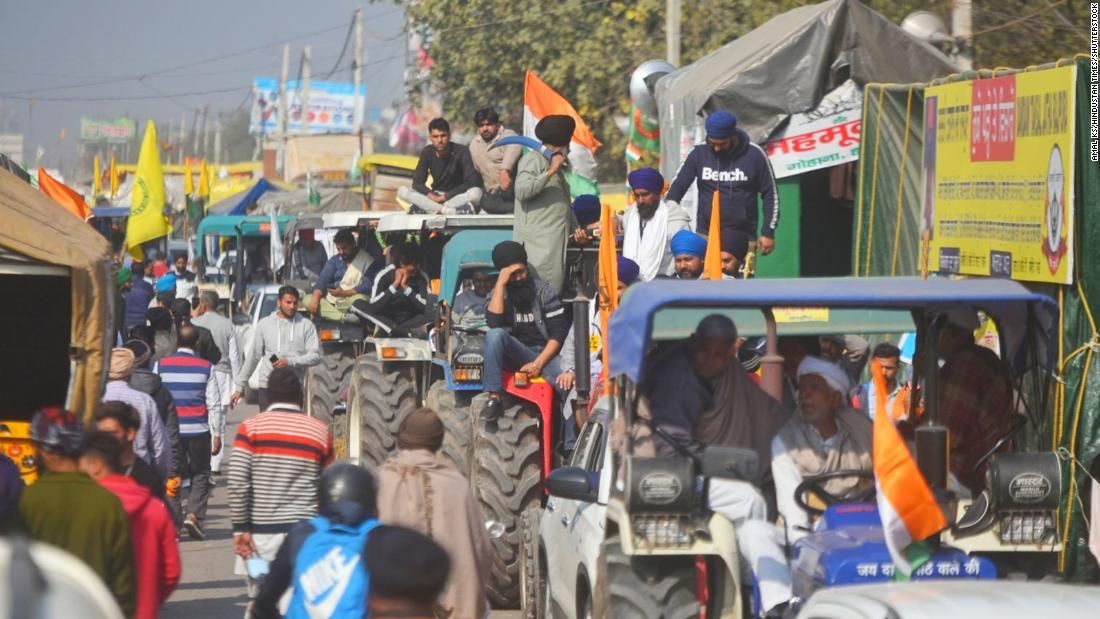
INDIA: Last week saw the government of the Indian state of Harayana enforce a mobile internet shutdown, to run until February 1st (now extend to 5pm on Feb 3rd), as a means of suppression against the Farmers’ Protests currently gripping India. On January 31st, the Internet Freedom Foundation (IFF), Free Software Movement of India (FSMI) and the Software Freedom Law Centre India (SFLC) released a joint statement that condemned the use of internet shutdowns by the government:
We, the undersigned organizations and individuals, strongly condemn the internet shutdowns imposed by central and state government authorities to suppress the farmers’ protests at the borders of the National Capital Territory of Delhi. At present, there are lakhs of farmers who are protesting against the central government’s attempt to deregulate and privatize India’s agricultural sector which they believe would destroy their livelihoods. The farmers have been peacefully protesting at the Singhu, Tikri and Ghazipur borders for two months. However, subsequent to the Republic Day tractor parade on 26 January 2021, there has been a crackdown against the farmers protesting at the borders with electricity and water supply also being allegedly cut off in some areas. Most disturbingly, there have been reports of violence being inflicted upon the farmers by unidentified mobs and police personnel. It is against this backdrop that we raise alarm about the use of internet shutdowns by government authorities to suppress the free flow of information related to peaceful assembly and the fundamental right to protest.
To read the joint statement in its entirety, please click here.
Twitter blocks accounts at the Indian Govt’s behest…
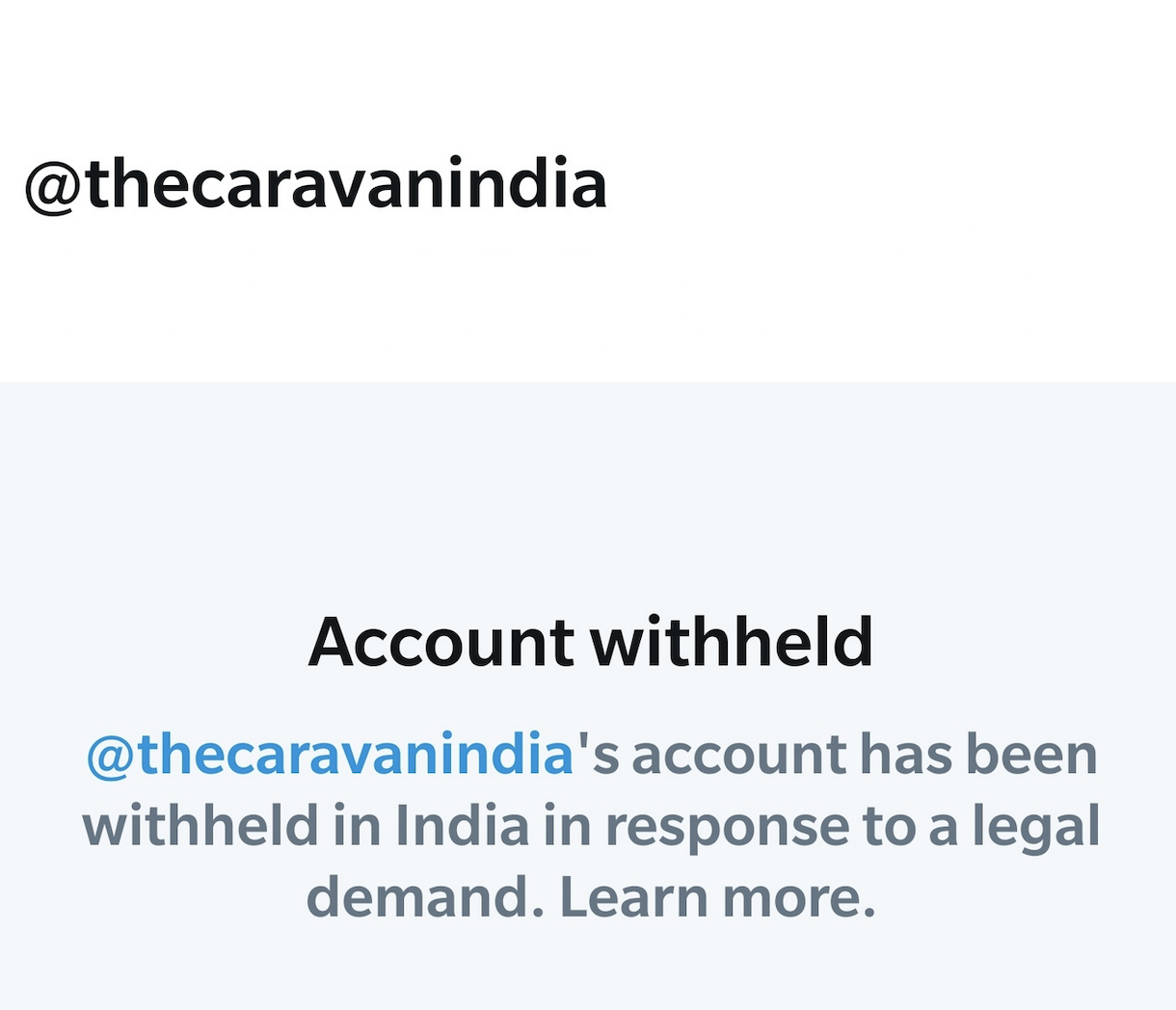
The Indian government didn’t just stop there, however. As reported by SFLC, IFF, Al Jazeera and others, Twitter temporarily blocked 250 accounts from being viewed in India, if they had been covering or discussing the Farmer Protests, though some have since been restored. According to Reporters Sans Frontières/Reporters Without Borders, what the accounts in common was “the inclusion of hashtags referring to the protests”, with the block evidently being at the Indian government’s request. RSF also reported on at least ten Indian journalists being arrested and charged with sedition(!) for covering the protests.
As IFF, SFLC et al have pointed out, the action taken by Twitter appears to stem from Section 69A of India’s Information Technology Act 2000. Similar to Section 37 of Pakistan’s own Prevention of Electronic Crimes Act, Section 69A of the Indian IT Act gives the government the power “to issue directions for blocking for public access of any information through any computer resource”, if seen to be
…necessary or expedient so to do in the interest of sovereignty and integrity of India, defense of India, security of the State, friendly relations with foreign states or public order or for preventing incitement to the commission of any cognizable offence relating to above, it may subject to the provisions of sub-sections (2) for reasons to be recorded in writing, by order direct any agency of the Government or intermediary to block access by the public or cause to be blocked for access by public any information generated, transmitted, received, stored or hosted in any computer resource.
This Section was also used to block 59 Chinese apps after a military clash between India and China along the India-China border last June. SFLC did a deep dive shortly after last summer’s app block, and noted that at the time there had “been no press release for these additional apps or any order”, and they had “filed a RTI* to get the order.” That analysis can be found here.
…with Rihanna, Greta, Mia & a lot more people finding out.
When the Indian government shutdown mobile internet access in Harayana and leaned on Twitter to block around 250 accounts for discussing the Farmers’ Protests, it appears that they did not except criticism to be widespread outside of the Subcontinent, save for a few politicians and activists. In the past couple of days, however, tweets by Rihanna, Greta Thunberg, Mia Khalifa, and several others - including Meena Harris, niece of the recently elected US Vice President Kamala Harris - have brought additional (and in India’s mind, presumably unwanted) attention to the Indian governnmen’s crackdown on freedom of expression and information concerning the Farmers’ Protests. Rihanna’s pretty darn good question was retweeted by Jagmeet Singh, the leader of Canada’s centre-left/left-wing New Democratic Party, which has also released a petition calling on PM Justin Trudeau to condemn the actions* of the Indian government against the farmers, and Claudia Webb, an MP with the British Labour Party.
As Deutsche Welle, Al Jazeera and other outlets have reported, the Indian government has not taken this well, with the Foreign Ministry saying that:
It is unfortunate to see vested interest groups trying to enforce their agenda on these protests, and derail them.
The Ministry went on to say:
Some of these vested interest groups have also tried to mobilize international support against India. Instigated by such fringe elements, Mahatma Gandhi statues have been desecrated in parts of the world. This is extremely disturbing for India and for civilized society everywhere.
and:
Before rushing to comment on such matters, we would urge that the facts be ascertained, and a proper understanding of the issues at hand be undertaken.
“Don’t rush in before you know all the facts” is, unfortunately, a common refrain that has been used across South Asia, the Global North and South, as a means of trying to deflect criticism of draconian measures - in this situation, for instance, those measures include (according to Deutsche Welle):
After a recent violent clash in the capital, police shut down water and electricity supplies, severed internet and social media links, dug ditches, drove nails into roads, removed mobile toilets and rolled out razor wire to stop the farmers driving their tractors into the city.
“Nails in the road”? “Severed internet and social media links”? Perfectly normal behaviour for a country that purports to be a democracy.
As we covered last week, India’s essentially the world’s internet shutdown capital, with more shutdowns in 2019 than any other (democratic) nation, according to Access Now and its #KeepItOn campaign. We’ve seen shutdowns being used in Indian-administered Kashmir and Harayana, among other parts of India, with SFLC’s Internet Shutdown tracker putting the most recent number at 468. India is not the only country to use shutdowns as a means of suppression and control - as Zainab K. Durrani at Digital Rights Foundation wrote last September, Pakistan, India’s neighbour, has also utilised it more than once, and for similar reasons. What the shutdowns and blocks show, according to a piece written for The Conversation by Subir Sinha, Senior Lecturer at SOAS,
India’s control over the internet is comparable to some of the world’s most authoritarian countries. While India ranks second in the world in terms of mobile internet subscribers, the country also leads in shutdowns. They’re used with alarming regularity to disrupt protest movements and – in the case of Kashmir, currently under the world’s longest internet shutdown – to control entire populations.
and
In Kashmir, where there are tight restrictions on the rights to free expression, speech and assembly, internet shutdowns function as an “invisibility cloak” to crack down on dissent and isolate Kashmiris from the rest of the world. Because India’s supreme court has ruled that “indefinite internet shutdowns” are illegal, India’s government instead downgrades or “throttles” Kashmir’s mobile connectivity from 4G to 2G, seriously limiting what can be loaded on phones.
Sinha also notes that Modi’s far right government has also utilised disinformation when attempting to retain control of a narrative (akin to we see in Pakistan and Nepal when comments/articles are critical of the government and the military):
At a pivotal moment, some protesters raised a flag sacred to Sikhs next to the Indian flag, even as movement leaders pleaded with them to climb down. Hundreds of cameras caught the moment the flags where raised, uploading photos to social media.
These images were immediately seized upon by social media influencers loyal to Modi, who began a disinformation campaign which spread across the country, claiming the flag to be that of Khalistani* separatists. In Modi’s India, separatists are often depicted as enemies of the state.
Vakasha Sachdev, Associate Editor at India’s independent online magazine The Quint, tweeted a thread that called out the disinformation tactics at work as well. Mohammad Zubair, fact-checker and co-founder of India’s fact-checking organisation, AltNews, tweeted the following (which does encapsulate Indian/Pakistani social media wars whenever things flare up IRL. Also, it’s funny.)
Shorbori Purkayastha, host of The Big Story podcast at The Quint, asks if Rihanna bringing attention to the protest means that “this renewed international support” will be “a significant turning point in the farmers' protest.” As the Financial Times has reported, however, the government wants Twitter to “re-block” those accounts that been temporarily blocked, or else face legal penalties as per Indian law, including fines and/or “ an imprisonment for a term which may extend to seven years.”
It is not clear or certain where the protests will go from here, or what the government will do. Will the government buckle, or will it continue to crack down on protests and freedom of expression online and offline? As Amrit Wilson wrote in The Tribune recently:
There can be no doubt that the Modi regime has been weakened. Will its draconian assault on the farmers movement stop it in its tracks? Or will the movement’s colossal magnitude and its unity be able to brush these obstacles aside like so much debris?
*Right To Information request.
Myanmar’s Military Junta orders Social Media Shutdowns
MYANMAR: February 1st (Monday) saw Myanmar’s military junta come back to power by force once more, detaining the country’s de facto* State Counsellor** and Noble Peace Prize laureate Aung San Suu Kyi, along with the country’s President Win Myint and several civilian political allies. Suu Kyi, Myint, their allies and fellow National League for Democracy party members were seized the day before a new session of parliament was to take place and before new members of parliament could be sworn in, after the NLD won another landslide victory in the November 2020 general election. Several charges have been laid before Suu Kyi, including, according to the BBC, “breaching import and export laws and possession of unlawful communication devices***.”
The junta, which ruled Myanmar from 1962-2011, has also implemented a year-long state of emergency, and claimed that they acted as there had been widespread electoral fraud on the part of the NLD, a claim that has been denied and found to be false by the country’s own electoral commission.
In addition to international condemnation of the coup, led by the United Nations Security Council and the UN Secretary General Antonio Guterres, there have been mass protests by Burmese citizens both in the country and overseas, with many taking to social media to voice their dissent and to organise protests against the military regime.
In retaliation, the military junta on Monday ordered internet service providers in the country - including mobile internet - to block access to Facebook. WhatsApp and Instagram, owned by Facebook, also faced complete blocks or limited access. The junta said that the block would stay in place until Sunday, February 7th.
The block, ordered by Myanmar's Ministry of Communications and Information was ostensibly in place because:
people, who are troubling the country's stability, are spreading fake news and misinformation, and causing misunderstanding among people by using Facebook.
The military has also said that it would go after VPN servers, with reports indicating that demands for VPNs having gone up over approximately 4000%. The offline messaging/mesh networking app Bridgefy ( This past Thursday Buzzfeed reported on how the Pakistan Telecommunication Authority, one of the Government of Pakistan’s regulatory bodies, forced Google and Apple to take down apps that were by and for the persecuted Ahmadi community The article points to and highlights the stepping up of the PTA’s global ambitions to pursue a community that has persecuted for decades, at a time when it purports to defend minorities.
This is not the first time that the PTA has played moral arbiter, or has had plans to do so on at a global stage, but as the Buzzfeed article points out:
The pressure on multinational tech companies from Pakistan’s telecom regulator, the Pakistan Telecommunication Authority (PTA), signals a new willingness to target religious minorities beyond its borders. It is also one of the first examples of governments using anti-blasphemy rules to force international tech companies to censor content.which utilises Bluetooth technology to allow users to communicate sans ‘normal’ internet access), saw over a million downloads within Myanmar within a day of the social media block coming into effect.
Raman Jit Singh Chima, Senior International Counsel and Asia Pacific Policy Director at Access Now, said in a statement that:
Cutting connectivity at a moment like this is far too often used to obscure abuse and repression, and facilitate impunity. All Myanmar authorities, including the military, must immediately act to restore uninterrupted connectivity in the country and to all people, no matter their political beliefs.
As Burhan Wazir writes for Coda Story, there is concern that the military government will implement further draconian methods, with one interviewee claiming that:
“From a freedom perspective, I believe there will be more control of internet traffic,” said an employee of Internet in Myanmar, a technology news website, who spoke on condition of anonymity. “Since the last few months, the government started to introduce some filtering, I think we should expect that will happen more and more.”
* The Myanmar Constitution, although her National League for Democracy party won a landslide victory in 2015, prevents her from becoming President of the country as her children are foreign nationals, according to this profile by the BBC. Given her international profile and control of the NLD party, however, she is regarded as the de facto civilian head of the country in all but name.
**According to Wikipedia, this position and title is equivalent to that of Prime Minister.
*** According to a report by Deutsch Welle,
Military officers who searched Suu Kyi's residence found 10 hand-held radios that were imported illegally and used without permission, the document from a police station in the capital Naypyitaw said.