
“block, delete, or modify published news anywhere in the country without judicial oversight”
India implements its own Digital Media Rules; Pakistan govt told to amend its Social Media Rules by April 2nd; Pakistan court grants bail in a blasphemy case.
India and its Digital Media Rules
The ongoing farmers’ protests have, as we’ve noted more than once, brought more attention to attempts by the Indian government (echoing others) to curb and control freedom of expression that questions or counters the official narrative. The nationalist Modi government has, as has been widely reported, threatened to throw local Twitter employees in jail for the social media giant’s refusal to continue blocking Twitter accounts from being viewable in India.
In addition to having activists picked up by the police for sharing a “digital toolkit” on charges of “sedition”, and promoting local “nationalist–approved” social media alternatives (that can come more easily under the government’s remit), the Indian government has also sought to control freedom of expression via the enactment of regulations that echo that of Pakistan’s own Social Media Rules.
Coming into force on February 25th, the “Information Technology (Intermediary Guidelines and Digital Media Ethics Code) Rules, 2021” - or, as referred to colloquially online, “Digital Media Rules” - have been described by digital rights organisations such as India’s Internet Freedom Foundation as “fundamentally” changing “the way the internet will be experienced in India.” As with its Pakistani equivalent, there is scepticism with regards to the government’s assertion that,
The proposed framework is progressive, liberal and contemporaneous…It seeks to address peoples’ varied concerns while removing any misapprehension about curbing creativity and freedom of speech and expression.
In reality, what the Digital Media Rules do is give power to the government to control not just online news outlets and social media platforms, but interestingly digital streaming video platforms such as Netflix, HBO, Amazon etc - platforms that had already undertaken some forms of self-censorship - sorry, incorporated “self-regulation toolkits” - in preparation for these very same rules.
The Digital Media Rules have already been invoked at least once, against Manipur-based journalist Paojel Chaoba, Executive Editor of the digital news outlet The Frontier Manipur - and, interestingly, in response to an online discussion uploaded on February 28th to the outlet’s Facebook page, on the Digital Media Rules themselves. A notice was delivered in person to Mr. Chaoba’s home, and requested that both he and his outlet:
furnish all the relevant documents showing that you ensure compliance of the provisions of the Information Technology (Intermediary Guidelines and Digital Media Ethics Code) Rules, 2021; failing which steps as deemed fit shall be initiated without further notice.
Later that same day, however, Mr. Chaoba received another notice that stated the earlier notice “stands withdrawn with immediate effect.”
According to India’s Newslaundry website - which had spoken with Chaoba and had reported on the about-face - the initial notice had been withdrawn as, according to the government, “states did not have the power to take such steps." Quoted by the Hindustan Times, the Minister for Information and Broadcasting, Prakash Javadekar, said that the “mechanism is mostly self-regulatory and only in very serious cases can they complain to the ministry.”
A notice was sent to the head of a digital media outlet, and then was, yes, withdrawn. The situation may speak to an immediate sense of confusion and lack of coordination at the local level, but it also speaks to a concern that government officials now believe themselves to be in possession of another means of censorship and control through the new Digital Media Rules. As Variety magazine reported earlier this week,
Social media platforms are not allowed to “host, store or publish any information prohibited by any law in relation to the interests of the sovereignty and integrity of India: the security of the State; friendly relations with foreign States; public order; decency or morality; in relation to contempt of court; defamation; incitement to an offence, or information which violates any law for the time being in force.”
As Variety also reports,
Platforms are now required to appoint one of their employees as a ‘Resident Grievance Officer,’ who is resident in India and is an Indian passport holder. If users want to voluntarily verify their accounts, the platforms are required to enable this and provide a mark of verification visible to all users.
Further to this, and as per the Digital Media Rules, Variety goes on to report, social/digital media platforms must remove or “disable access to the offensive content within 36 hours of receiving a directive to do so.”
The Editors Guild of India released a public statement on March 5th that stresses their concern that the government could “block, delete, or modify published news anywhere in the country without judicial oversight” and that the rules have the “potential to seriously undermine media freedom in India.”
Interestingly, the statement also makes the claim that the “Government did not consult stakeholders before notifying these far-reaching rules.” Once again, this echoes statements by digital rights activists and tech companies across the border and overseas that assert that Pakistan’s own government did not bother to get input from them (even as the government claims otherwise).
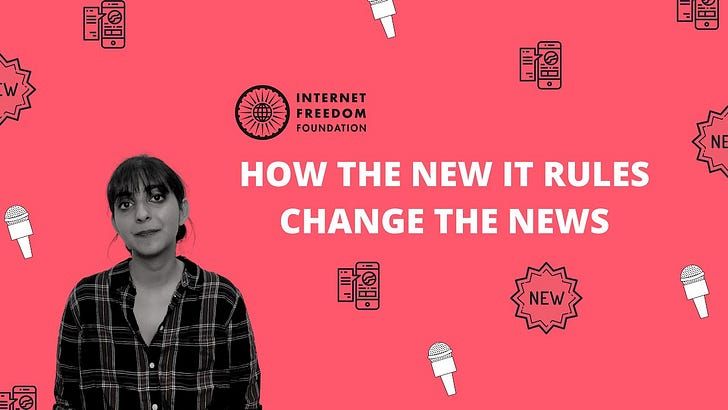
India’s Internet Freedom Foundation, which has covered the Digital Media Rules extensively, has provided a detailed “deep dive” and Twitter thread discussing the Rules, as well as a video explainer as to what they hold for how news reporting can be impacted.
Adios, E2E?
The “deep dive” is a brilliant source of information as to what the Rules will do, and what they will do is troubling, to say the least. According to the IFF, the Rules could potentially spell an end to end-to-end (e2e) encryption:
Significant social media intermediaries must enable tracing of the originator of information on their platform if required by a court of competent jurisdiction or a competent authority under Section 69A of the IT Act [Rule 4(2)]. While the Intermediaries Rules clarify that traceability order may only be passed for serious offences, some categories are open-ended. For instance, “public order” grounds are relatively broad in operation and can give rise to many demands. The Intermediaries Rules also clarify that in doing so, the significant social media intermediary shall not be required to disclose the contents of any electronic message, any other information related to the first originator, or any information related to its other users. However, the Information Technology Decryption Rules contain powers to make demands for the message content. Used together, the government will break any type of end-to-end encryption to gain knowledge of who sent what message and also get to know its contents. Also, this specific requirement will break existing protocols for the deployment of end-to-end encryption that has been built through rigorous cybersecurity testing over the years!
End-to-end encrypted messaging services aren’t just used by activists or journalists, but by government officials and foreign diplomats, all of whom may be discussing sensitive information. If the government of India were to indeed be able to “break any type of end-to-end encryption to gain knowledge of who sent what message and also get to know its contents”, that can instil a chilling effect, and cause a scramble for other services. Further to this, even if an e2e messaging service is zero-knowledge ie it holds no information about its users - eg Signal - concerns about breaking the law (and thus limiting their market presence) could see Apple, Google and other app store-fronts decide to remove e2e apps from their localised app stores, though this remains to be seen.
As Christophe Jaffrelot and Aditya Sharma wrote for the Indian Express on March 4th,
The introduction of these rules expands the already considerable control the Indian government’s executive branch maintains over digital entities. With the increasing repression faced by protestors and print as well as electronic media, the digital realm has become one of the last arenas of mostly free speech in India. These rules, by ramping up the liability of digital firms for the content that they host or produce, will likely have a severe impact on free expression and privacy, contributing to the rapidly shrinking space for dissent in India today.
Pakistan’s Social Media Rules to be revised by April 2nd
The Pakistani government has been given until April 2nd by the Islamabad High Court revise its Social Media Rules (aka “Removal and Blocking of Unlawful Online Content Rules 2020”). As Digital Rights Monitor reports, the new deadline comes after Pakistan’s Deputy Attorney General, Syed Tabib Shah, made a request to the Islamabad High Court for an additional month to hold consultations with stakeholders - and that the Attorney General “would submit his report in the High Court after the consultation process.”
The apparent desire to listen to concerned stakeholders comes after a meeting held on February 19th between the Attorney General, Khalid Jawed Khan, and a small number of stakeholders, as ordered by the IHC at the end of January 2021. According to Digital Rights Monitor, the meeting included - or had at least invited:
Chairman Pakistan Telecommunication Authority (PTA), the Secretary of the Ministry of Information Technology and Telecommunication (MoITT) and the Secretary of Cabinet Division have also been asked to attend the consultation on the 19th of this month. In addition, the President of Pakistan Federal Union of Journalists (PFUJ), President of the Press Association of Supreme Court Abdul Qayyum Siddiqui, and President of Press Association of Islamabad High Court Saqib Bashir are also summoned for the stakeholder meeting. Jeff Paine, the Managing Director of the Asia Internet Coalition (AIC) which is a 12-member coalition of global tech companies including Facebook, Amazon, Google and others, is also invited.
Petitioners who challenged the Social Media Rules in Islamabad High Court, including, Awami Workers Party, journalist Amber Rahim Shamsi and other petitioners will also be in attendance.
The inclusion of the AIC is sensible but also interesting, given its public statements that “the consultation never occurred,” contrary to the government’s own claims.
Aside from the bodies mentioned in the quote above, it appears that Pakistani and international digital rights organisations were not invited to the February 19th. Should the government decide to not involve said organisations between now and April 2nd, it could be possible that we could see little in the way of actual progress, as was the case with the Prevention of Electronic Crimes Act.
Pakistani high court grants bail to defendant in online blasphemy case
Earlier this month a young Pakistani Christian man was granted bail by the Lahore High Court, after spending four years in prison after being accused of allegedly committing blasphemy online. Now twenty years old, Nabeel Masih was arrested at the age of sixteen in 2018, making him the youngest person to be charged and convicted in Pakistan, where blasphemy carries a prison sentence and fine, as well as the death sentence. According to the Washington Post, the accusation of blasphemy was thrown at the then-teenager by a mob claiming that he had shared a picture of the Kaaba (the holiest site in Islam) in Mecca on Facebook*. It has not been made clear when or if he will be released.
As is often and frustratingly the case, there are no details that can explain or justify (even flimsily), as to what it is exactly that Nabeel Masih supposedly did to earn prison time. As I wrote in early January, this vagueness is perhaps unsurprising, as:
aside from the nebulous and subjective definition as to what actually constitutes blasphemy, there is also the very legitimate worry of inflaming tensions and causing mass riots etc, as witnessed in the wake of the infamous Jyllands-Posten Muhammad caricatures and the framing of a young Christian girl by a Muslim cleric of burning pages of the Quran, that led to her and her family seeking refuge overseas, but to name a few. Chaudhry Nisar Ali Khan, Interior Minister in the previous Nawaz Sharif government, had in 2017 said that Pakistan would ask for the extradition of anyone found to have to committed blasphemy online overseas (again, very broad, nebulous and subjective).
Similar to this, The Guardian recently reported on the delayed appeals of a Pakistani Christian couple that had been accused of sending “blasphemous” texts, and have been on Death Row since their 2014 conviction. Should the couple and Nabeel Masih have their convictions overturned/be released respectively, it is likely that they would have to leave the country - as was the case with Asia Bibi, a Pakistani Christian woman who was falsely accused of blasphemy and sentenced to death in 2010, had her sentence overturned, and who received asylum in Canada, where she still receives death threats.
In 2011 the then-governor of Punjab and the minister for minorities were both assassinated for drawing attention to Asia Bibi’s case, and for campaigning for reform to Pakistan’s blasphemy laws.
As I also wrote in early January,
Even prior to the Prevention of Electronic Crimes Act being enacted in 2016 - and which itself gives powers to the government to block “blasphemous” material online - the Pakistani university lecturer Junaid Hafeez was accused of making blasphemous comments on Facebook in 2013 (it’s likely that being a moderate liberal he was targetted by the student wing of the powerful far right Islamic fundamentalist Jamaat-e-Islami political party). In 2014, his lawyer, Rahid Rahman, was gunned down in his office, and in December 2019 Hafeez was given the death sentence, where he currently sits.
With spaces for dissent and liberal discourse rapidly shrinking offline and now online in Pakistan, rulings and sentences such as the ones this past Friday highlight the dangerous situation that Pakistanis find themselves in.
*A report by Dawn appears to indicate the image at the heart of the accusations was allegedly shared in a WhatsApp group, though Nabeel Masih’s lawyers asserted that the “forensic report” showed that it did not come from him.